

Robotics Data Practice: Confirm the Date Format First
2026-11-03
Robotics Data Practice: Confirm the Date Format First
A robotics dataset arrives with numeric dates separated by slashes. Some entries could be read with either the month or day first, and both interpretations appear plausible. Converting the column immediately can turn uncertainty into apparently precise dates. Begin by preserving the source strings and finding the declared date format. This article describes a preparation method, without converting a real dataset or reporting a change in an industry trend.
Retain the raw column and its source explanation
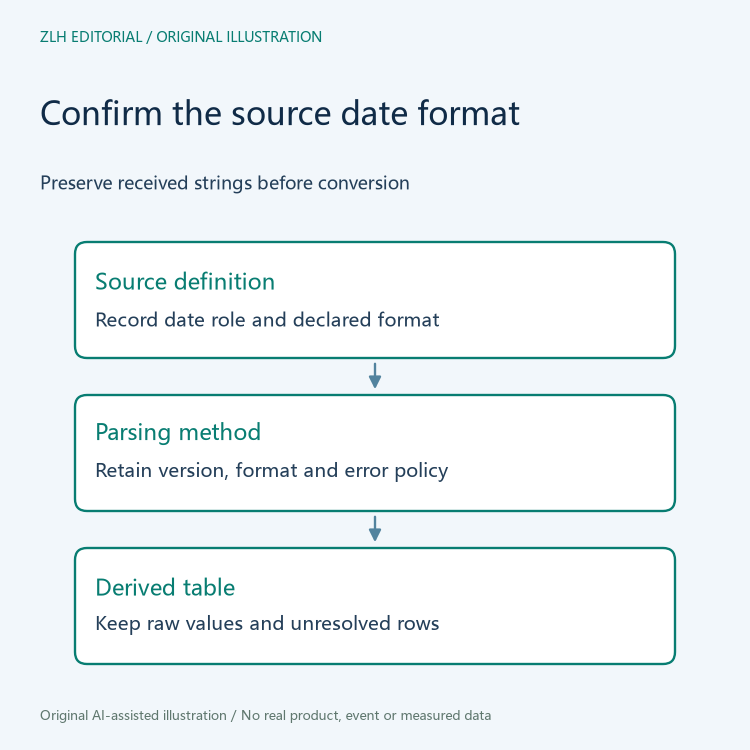
Save the received file, its identity and the column definition before creating a parsed copy. Keep the original date text alongside any derived value. If the delivery includes a data dictionary, record the edition that applies to this file. A convention described for another release or a neighboring column may not explain the values currently under review.
Ask what the date represents as well as how it is written. A collection date, publication date and revision date can use the same format while describing different events. Record that role independently. The country of a vendor, the language of a website or the analyst's own computer settings should not be used as a substitute for the source's date definition.
Choose a parsing rule from evidence rather than preference
The pandas to_datetime documentation describes explicit formats and warns that dayfirst is a preference rather than a strict rule. A successful conversion under a preference therefore does not prove that the source intended that interpretation. Record the documented format and the applicable parser settings together.
If the provider confirms a complete format, a technical reviewer can configure the relevant string parsing accordingly. Keep the tool version, exact-format policy and error handling in the method record. Do not silently enable a mixed-format guess merely because it accepts more rows. A column may genuinely contain multiple declared formats, but that requires an explicit account of which records use which convention.
Where the format is unresolved, preserve the uncertain entries for clarification. Values that happen to disambiguate one part of a file can be useful clues, but they do not automatically establish a rule for every row. An analyst should explain the evidence used and any boundaries rather than announce that the pattern was obvious.
Separate a date representation from a complete timestamp
RFC 3339 specifies an Internet timestamp format and defines its full-date component using year, month and day in an explicit order. That provides a precise reference when a delivery actually declares that convention. It is not a license to describe arbitrary slash-separated strings as RFC 3339 timestamps.
A calendar date without a time or offset should remain identifiable as such. Do not append an invented event time simply because the receiving database uses a timestamp field. If a local storage convention is necessary, document it as a representation decision and retain the original date precision separately.
Make failures visible in a derived working table
Before using derived dates for sorting or aggregation, account for rows that failed the stated conversion rule. Preserve row identifiers and the original values so the provider can investigate. A parser exception is a preparation finding; it is not evidence that the underlying industry event never occurred.
If the chosen workflow converts failures to a missing marker, retain a separate failure inventory. Otherwise, invalid dates can disappear into a general missing-value category and be excluded from a chart without explanation. Do not replace failed values with the file's publication date, a neighboring row's date or the analyst's observation date.
Check the parsed copy against a source-confirmed subset, explaining how that subset was chosen. A small comparison is limited evidence, not a guarantee that every record is correct. Keep subsequent corrections linked to affected row identities so later transformations can be reviewed without rewriting the received file.

Deliver a date dictionary with the prepared dataset
The handover should name the source column, event role, declared format, parsing configuration and unresolved entries. Distinguish the publisher's explanation from the analyst's local conversion policy. This makes the result reviewable when another person groups records by month or joins them to a separately dated dataset.
When a source revises its date convention, retain both deliveries and update the conversion method explicitly. Do not reuse a previous parser solely because the column name has stayed the same. A correct historical transformation can become inappropriate for a new file, and a stable chart appearance does not establish that the dates retained their meaning.
The original diagrams illustrate preparation decisions without sample records or fabricated dates. Related methods appear in the robotics datasets and definitions collection and article directory. A confirmed date format keeps the uncertainty in the source visible until there is evidence to resolve it.


