

Robotics Data Delivery: Separate Encoding from Media Type
2026-11-02
Robotics Data Delivery: Separate Encoding from Media Type
Content encoding can change the representation a data client receives without changing the identity of the underlying media type. A robotics-data supplier should explain those layers before asking a buyer to accept a downloaded deliverable. This checklist concerns a fictional HTTP delivery arrangement. It sends no request, decompresses no file, and reports no dataset or transfer measurements. Its purpose is to make the received and inspected forms understandable.
Define the representation the buyer expects to use
Start with the intended data-reading task. Ask which representation the receiving application is supposed to inspect and what the supplier promises to deliver. A statement that the download is compressed does not identify the underlying data format or the form that a reviewer actually sees.
Keep the source object, the transport-related explanation, and the analytical task distinct. The buyer may need a readable data representation while the network exchange uses an additional coding. Neither statement alone establishes that the delivered observations answer a particular robotics research question.
Ask the supplier to name the layer in every size or content statement. A report about received coded bytes and a report about decoded data can both be useful, but they describe different things. The handover should not leave the receiver to infer that difference from whichever tool happened to display a number.
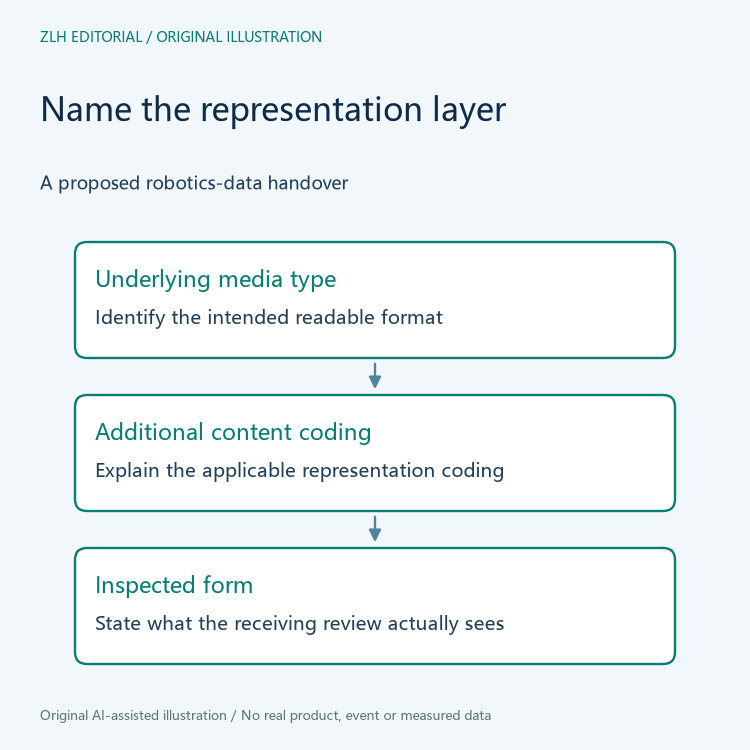
Read the media type and additional coding separately
RFC 9110, section 8.4, explains Content-Encoding as indicating codings applied beyond those inherent in the media type. It describes the decoding needed to obtain data in the media type referenced by Content-Type. This gives the acceptance note two related but distinct questions.
The supplier should identify what each field means for the actual delivery. Do not replace both with a generic compressed-file label. An underlying format that inherently uses compression is also a different context from an additional HTTP content coding.
The present checklist provides no real response fields. Documentation examples should remain examples, rather than become evidence about a supplier’s server. A later authorized observation needs the actual request and representation context attached.
Ask which form the receiving tool exposes
A receiving program may present a form after some processing. The buyer should ask the tool owner what was actually inspected, rather than assume that every displayed byte sequence is the original coded form from the response. The handover needs an explicit account of that boundary.
MDN’s Content-Encoding reference explains the coding field and notes that related representation metadata normally concerns the encoded form unless otherwise specified. This helps frame a question about the meaning of reported lengths. It is not a measurement of the current delivery.
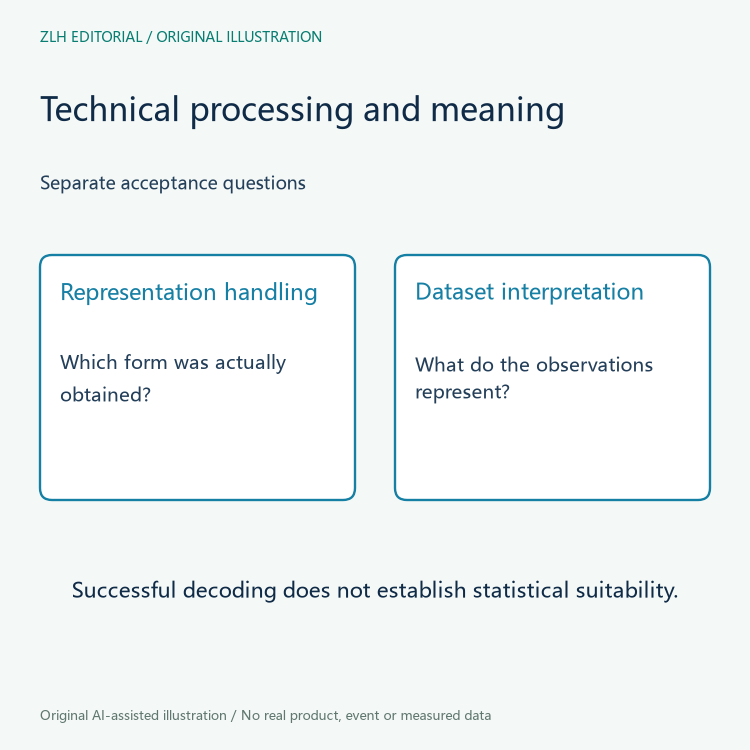
If the supplier supplies a validation record, it should say which form was checked. A statement about a decoded object should not be used as an unexplained substitute for a statement about coded content. Preserve both contexts when the acceptance task genuinely needs them.
Keep decoding and dataset interpretation as separate work
Obtaining a readable representation would still leave questions about its schema, units, coverage, and source. Additional coding does not explain those meanings. A procurement note should not turn a successful technical processing step into a completed statistical review.
The same applies to a failure. If an authorized later exercise cannot obtain the expected form, record the actual condition before assigning a cause. Do not declare the dataset corrupt or unavailable solely because one tool did not present the expected content.
This article carries out no such exercise. There is no real response body, parser output, or failed download to diagnose. A precise open item for the supplier is more useful than a plausible narrative invented to complete the report.
Record changes at the layer that changed
If the delivery arrangement changes, ask whether the underlying data, the additional coding, or the receiving processing changed. Those changes can require different follow-up checks. A new compression arrangement should not automatically be announced as a new robotics dataset.
Likewise, an updated dataset should not inherit an old interpretation review simply because the coding field remains the same. Keep earlier evidence with its original object and scope. The buyer should be able to identify what needs renewed examination.
Close with an explanation another receiver can follow
The acceptance record should identify the intended representation, the applicable coding explanation, the form actually inspected, and the remaining analytical questions. If one is unknown, preserve the gap rather than merge the layers under a success label.
More methods appear in our robotics dataset section and the reading directory. Both original illustrations describe delivery layers only, with no real header values, byte counts, decoded data, market figures, or observed transfer results.


