

Robotics Data Practice: Grouping Runs and Grouping Labels
2026-11-02
Robotics Data Practice: Grouping Runs and Grouping Labels
Grouping runs in a sequence is a different task from collecting everything with the same label. For robotics industry data, the distinction matters whenever the order of entries is meaningful. This article proposes an offline exercise using an imaginary sequence of category labels. It contains no market observations, transaction counts, or executed program output. The purpose is to choose the question before selecting a convenient data-processing operation.
Decide whether the question concerns sequence or totals
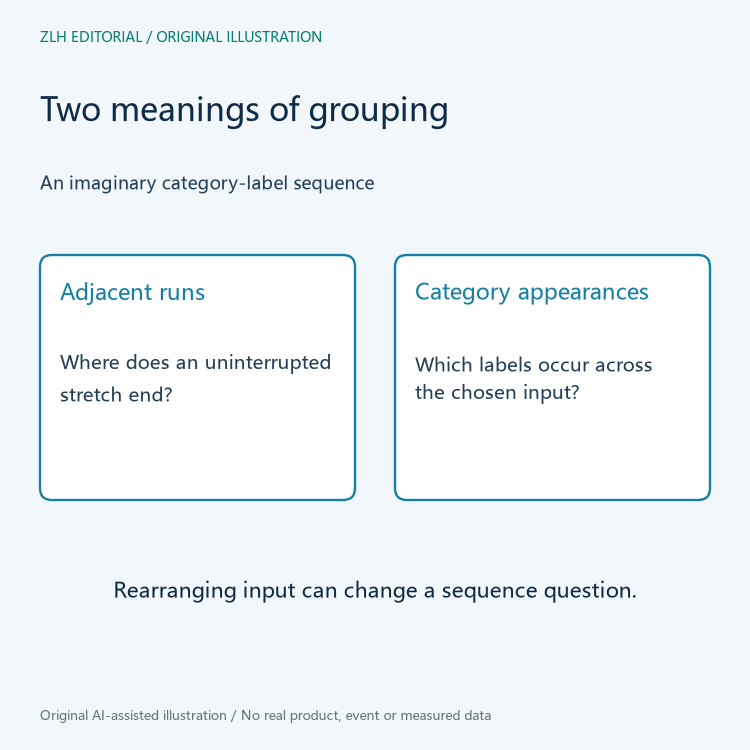
Imagine a teaching sheet whose rows are arranged in a deliberately stated order. A learner might want to describe uninterrupted stretches of one label. Another might want to summarize how often each label appears anywhere in the sheet. These are both reasonable questions, but they ask for different information.
Begin by writing the desired question in ordinary language. If it concerns an uninterrupted stretch, explain why adjacency matters. If it concerns all appearances of a category, say that the original position is not the main grouping criterion. Do not use the word group without explaining which meaning is intended.
The fictional sheet should retain its original ordering for comparison. Sorting immediately may make identical labels sit together, while also changing the very adjacency the first question asks about. A tidy-looking arrangement is not automatically a faithful answer to a sequence question.
Ask another learner what information would be lost if the rows were rearranged. The answer depends on the exercise purpose. This discussion should happen before any transformation, rather than after an attractive summary has made the original question difficult to recover.
Read adjacent grouping as a specific operation
The Python itertools documentation describes groupby as producing consecutive groups. That is the relevant bounded fact for this exercise. Its presence in a program does not mean the program has combined every appearance of a category across the entire input.
For the imaginary sequence, the learner should explain what would start a new run. The explanation concerns a change in the selected key as the input is traversed. A category can therefore be part of a later run without making it the same uninterrupted stretch as an earlier appearance.
This article supplies no fabricated run lengths. Instead, it asks learners to mark the intended boundaries on authorized teaching material if an instructor provides it. If no such observation has occurred, the boundary description remains a proposed exercise rather than a reported result.
A practical note can also identify which input order is being used. Without that context, a later reader may assume a run summary describes the original sheet when it actually describes a rearranged copy. Naming the order makes the meaning of the operation easier to understand.
For the classroom note, state the chosen key in words as well. Readers should know whether it identifies one category field or a deliberately defined combination, rather than guessing from the output labels alone.
Keep category counting separate from run structure
The collections documentation describes Counter as counting hashable objects. It provides a different starting point for a question about category appearances. The learner still needs to define what object is being counted and which input entries are included.
In the fictional lesson, a category summary would not preserve the sequence boundaries merely by listing labels and totals. If those boundaries matter to the reader, they should be addressed by a separate representation. One output should not silently claim to answer both questions.
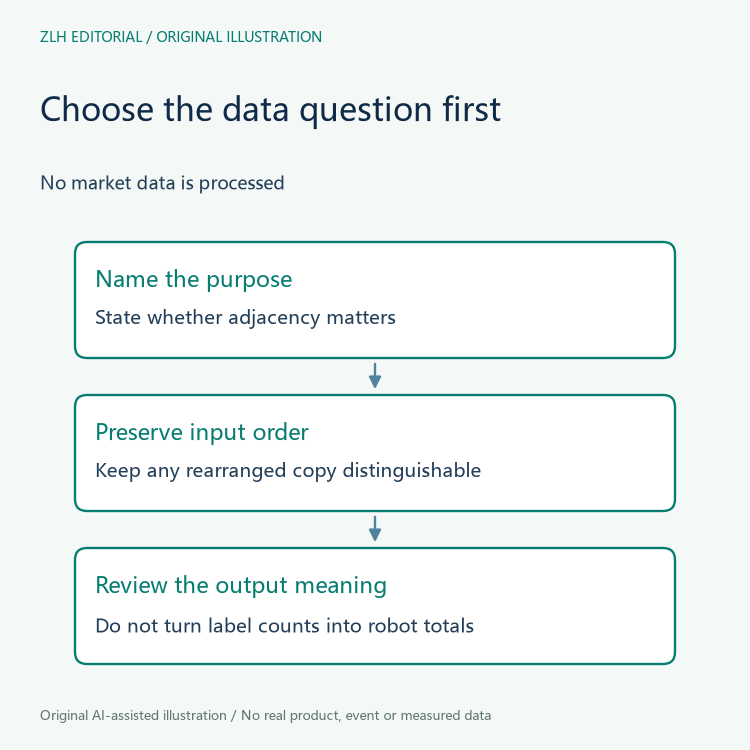
Nor would a count of labels automatically become a count of robots. The meaning of an entry must come from the actual dataset description. This article uses labels only, so it does not infer installations, operating machines, suppliers, or market shares from the exercise.
If an instructor later supplies real authorized teaching data, the scope should be explained before interpreting any total. The operation can organize the selected input, but it cannot invent a statistical population or establish that the source covers every relevant activity.
Review the answer against the original question
At the end, ask a second learner whether the proposed output describes uninterrupted runs or category appearances. They should be able to point to the original question and explain the match. If their explanation requires an unstated sorting step, that step needs to become visible.
A disagreement is an opportunity to clarify the operation, not a reason to relabel one output after the fact. Retain the original sequence and the stated purpose so the class can understand what was intended. No database, live data feed, or market report is changed by this article.
Related explanations appear in our robotics dataset methods section and the reading directory. Both original diagrams are qualitative teaching aids. They contain no actual sequence, invented counts, official statistics, or program results.


